
On the battlefield of digital marketing, how to build a "physically isolated" security fortress for each account?
On the battlefield of digital marketing, how to build a "physically isolated" security fortress for each account?
In the wave of globalization, operating multiple social media or advertising accounts has become standard practice for businesses to expand their markets. However, a ghost always lingers—account association and the accompanying risk of bans. Have you ever seen your meticulously operated account matrix collapse instantly due to a trace of association? With the evolution of platform risk control technologies, especially the popularization of browser fingerprinting and IP association detection technologies, simply changing IP addresses is far from enough. Today, we delve into a more fundamental proposition: how to build a secure advertising environment close to "physical isolation" levels, allowing each account to be like an independent, untraceable computer.
When "multi-account operation" becomes a necessity, security becomes the biggest vulnerability
For cross-border e-commerce, overseas marketing, content creators, and market research institutions, managing multiple platform accounts (such as Facebook Ads accounts, Google Ads, TikTok for Business, etc.) is an inevitable choice for business growth. Whether it's for testing different ad creatives, operating localized content, or conducting compliant competitor analysis, multi-account strategies are crucial.
However, the platform's logic is simple: they tend to judge multiple highly similar operational behaviors as originating from the same entity, especially when these behaviors share underlying network and environmental characteristics. Once deemed associated, the consequences range from restricted ad delivery to, in severe cases, the "collective punishment" and banning of all associated accounts, leading to the instant zeroing of accumulated customer data, ad history, and historical balances. This risk makes many teams tread on thin ice.
The "Achilles' heel" of traditional proxy solutions: You isolate the IP but expose the fingerprint
Facing association detection, the most common countermeasure is using proxy IPs. Many service providers claim to offer "clean" and "exclusive" IPs, which indeed solves the problem of isolation at the IP address level. But is the problem truly solved?
Reality is often more complex. Modern platform detection is multi-dimensional. They not only look at where your IP comes from but also deeply investigate your device and browser environment, namely the so-called browser fingerprint. Your operating system, browser type and version, screen resolution, installed fonts, plugin list, time zone, language settings, and even graphics card information—dozens of parameters—collectively form an almost unique "digital fingerprint."
Imagine this scenario: you log into multiple accounts through different proxy IPs, but all operations are performed on the same computer and in the same browser. To the platform's risk control system, this is like seeing the same person wearing different hats entering a building—the IP (hat) has changed, but the person (fingerprint) remains the same. The limitations of existing methods lie precisely here: they only address network-level isolation and ignore the unique identifiers at the application and environment levels. This incomplete protection leaves huge security risks.
From "point defense" to "systematic isolation": Logical deduction for building a secure environment
So, what should a truly secure advertising environment look like? We need to return to the ideal state of "physical isolation" to think about it. True physical isolation means: each account runs on a completely independent, newly configured computer and an independent network line, with no crossing at the hardware or software level between devices.
Clearly, this is unrealistic in terms of cost and operation. However, we can approach this state infinitely closely in the virtual world through technical means. A more reasonable solution should follow this logical deduction:
- Network-level isolation: Ensure each account's activity is bound to a unique, stable IP address that matches the account's geographical information. This is fundamental.
- Environment-level isolation: Create an independent, clean, and customizable browser environment for each account, ensuring its fingerprint information is unique and not associated with other environments.
- Operation-level isolation: Ensure that operational behaviors between accounts (login times, operating habits, even typing rhythms) have no machine-identifiable pattern associations.
- Management workflow integration: While achieving these complex isolations, the management difficulty should not be significantly increased, and efficient tools are needed to unify the management of scattered environments.
These four logical chains form the complete puzzle for building a secure advertising environment. Without any piece, the so-called "isolation" is incomplete.
In the practice of approaching "physical isolation," what role does IPocto play?
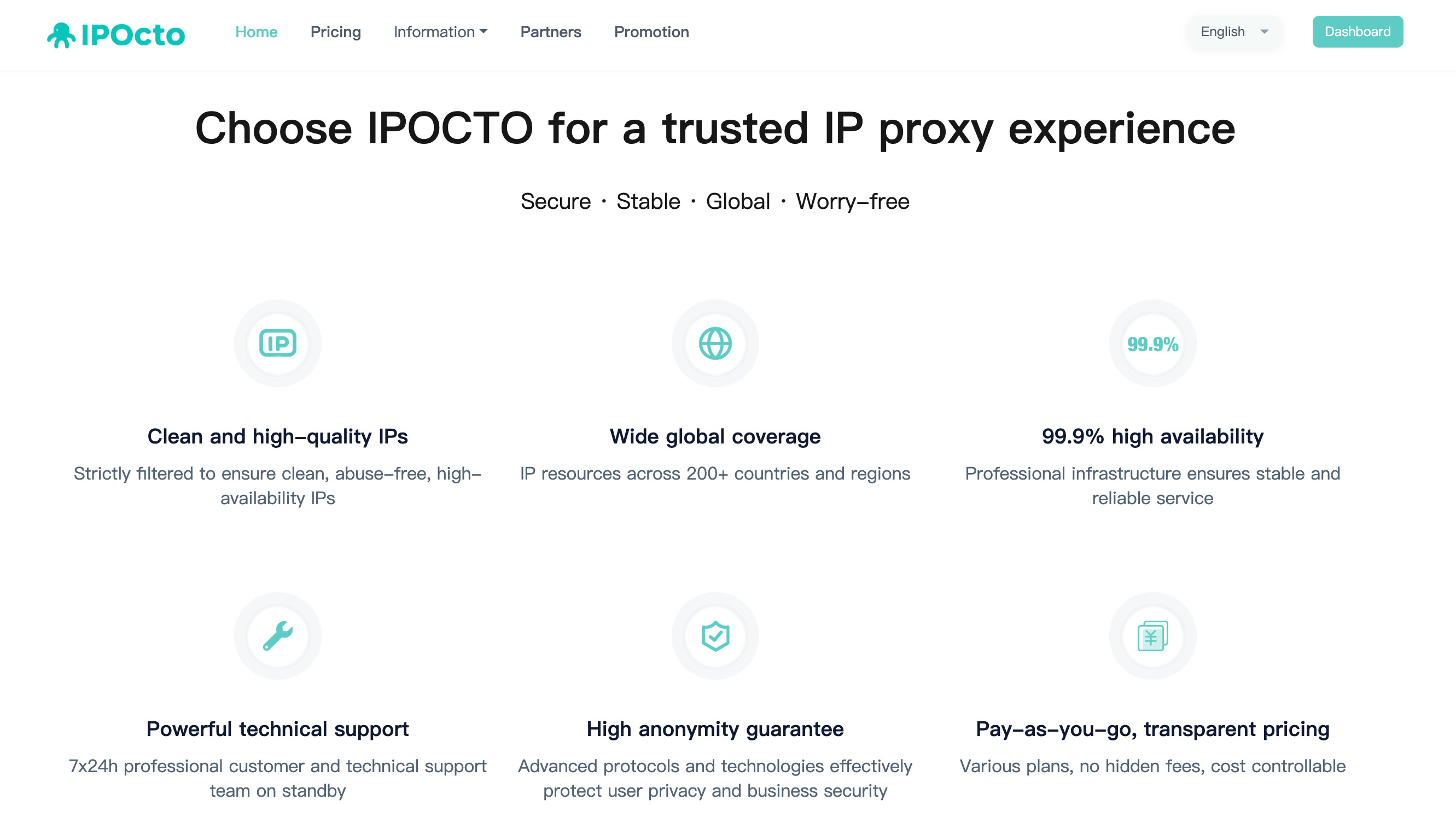
In the systematic solution described above, network-level isolation is the cornerstone and the first line of defense. This is precisely where global IP proxy services like IPocto can play a core role. A high-quality proxy service needs to provide far more than just a list of IP addresses.
- Cleanliness and Stability: The IP pool needs to minimize the risk of "blacklisted IPs" as much as possible and provide a high connection success rate, avoiding environmental fluctuations caused by frequent IP failures, thus unexpectedly generating association signals.
- Scenario Matching for IP Types: Choosing the appropriate IP type for different tasks is crucial. For example, for social media operations that require high simulation of real users and resistance to strict detection, static residential proxies may be a better choice; for large-scale data scraping, high-anonymity datacenter proxies can balance efficiency and cost. IPocto offers multiple proxy types to suit different scenarios.
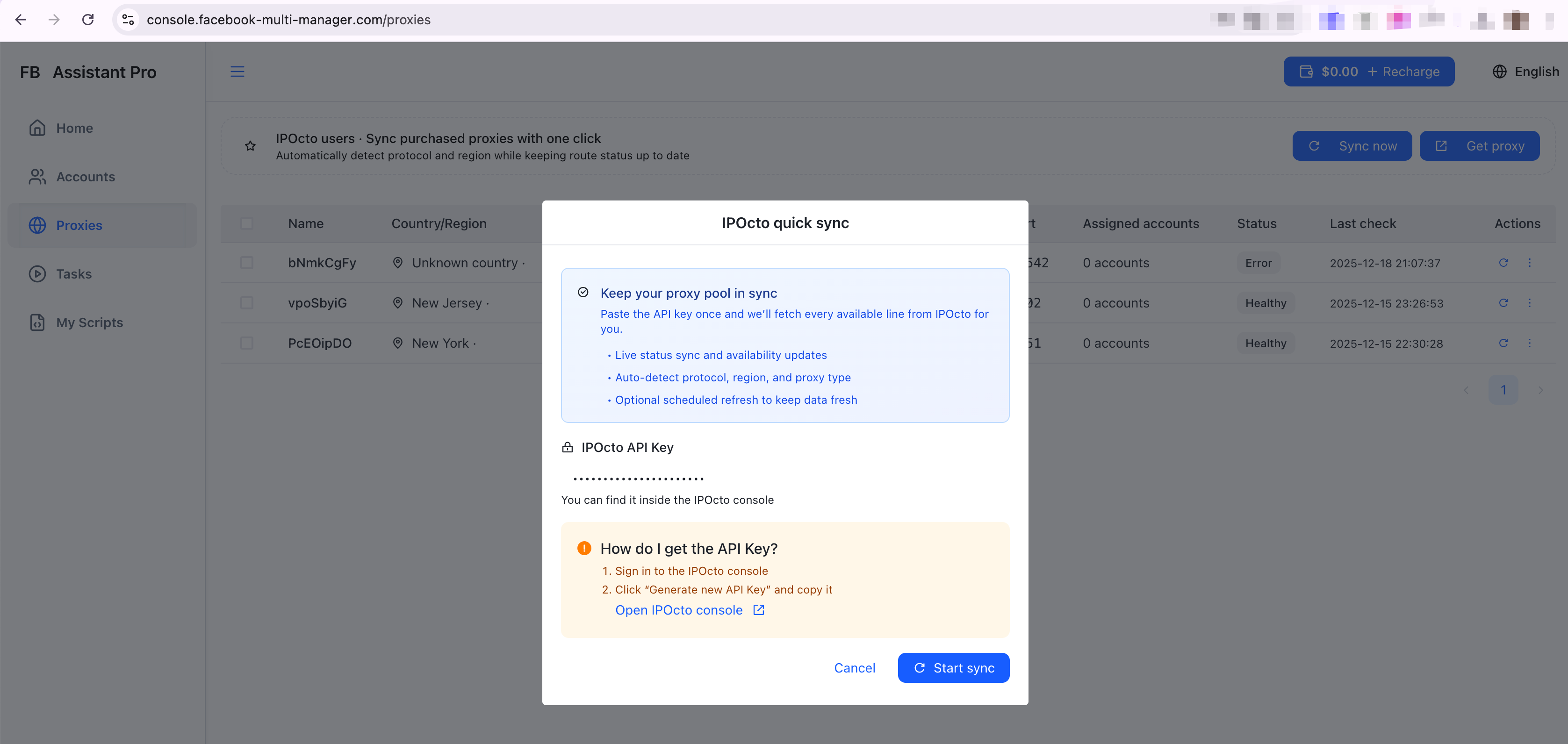
- Seamless Integration Capability: The ability to easily and stably integrate with mainstream multi-account management tools (such as FBMM, which will be discussed later) via API directly determines the landing difficulty of the entire workflow's efficiency and security.
The starting point of IPocto's fingerprint anti-association strategy is to provide such a batch of reliable, precisely configurable, and easily integrated network resources, laying a solid foundation for upper-level environment construction.
Practical Deduction: When FBMM Meets IPocto, Building a Matrix Security Firewall
Let's combine a real usage scenario to see how the above ideas can be implemented. Suppose we are a cross-border e-commerce team and need to securely operate 5 Facebook ad accounts in different regions simultaneously.
Traditional Inefficient and High-Risk Approach: Manually switching different proxy plugins in the browser, using notepad to record which IP corresponds to which account, and operating all accounts under the same Chrome browser through different user profiles or incognito windows. This easily leads to association due to operational errors or fingerprint leakage.
More Efficient and Secure Modern Workflow:
Environment Creation: We use a professional Facebook multi-account management platform—Facebook Multi-Manager (FBMM). In FBMM, we can create a completely independent browser environment for each Facebook ad account. Each environment can independently configure key fingerprint parameters such as language, time zone, and User-Agent, achieving environment isolation from the root.
Network Configuration: This is the critical step. We no longer use unstable browser plugin proxies, but integrate IPocto's proxy service into the browser environment settings of each FBMM. Through API or proxy links, we can assign a dedicated IPocto static residential IP to each environment and each account. For example:
Ad Account Target Country FBMM Browser Environment Fingerprint Configuration Bound IPocto Proxy Type & Location Account A USA English (US), Chrome Win10, New York Timezone Static Residential IP, New York Account B UK English (UK), Chrome Win11, London Timezone Static Residential IP, London Account C Japan Japanese, Chrome Win10, Tokyo Timezone Static Residential IP, Tokyo One-Click Sync and Launch: Thanks to the integration capabilities of the FBMM platform and IPocto, the above IP configuration can be completed efficiently, even with one-click synchronization. After launching, each FBMM window runs in a sandbox that is independent in fingerprint and IP.
Secure Operation: Team members operate different accounts through FBMM's unified panel, and all traffic is sent through the pre-set IPocto proxy channel. For the Facebook platform, the login and activities of these five accounts come entirely from five "computers" located in different countries with different hardware and software configurations, achieving the effect of approaching physical isolation.
The significance of this "matrix security firewall" is that even if one account encounters a review due to business reasons (not environmental reasons), other accounts, being in a completely isolated environment, will remain unharmed, truly achieving risk diversification.
Conclusion
In today's increasingly sophisticated platform risk control technology, secure multi-account operation is no longer a simple "IP changing" game. It is a systematic defense war surrounding the network layer, environment layer, and operation layer. The core idea of building a "physically isolated" security advertising environment is to equip each digital identity with a unique and consistent "digital passport" (IP and fingerprint).
This requires us to combine professional proxy network services with advanced environment management tools. By deeply linking high-quality, integrable IP resources provided by IPocto with environment management platforms like FBMM, we can build a strong matrix security firewall at a manageable cost, freeing global business expansion from future worries. Security is always the most solid foundation for growth.
Frequently Asked Questions FAQ
Q1: I'm already using proxy IPs, why is my account still associated and banned? A: This is likely because your browser fingerprint leaked associativity. Even if the IP is different, if you operate multiple accounts on the same device and within the same browser kernel, the platform can still determine that these activities are from the same source by collecting dozens of environmental parameters. You need to combine IP isolation with browser environment isolation.
Q2: What is the difference between static residential IPs and dynamic residential IPs in terms of anti-association? A: Static residential IPs remain fixed for a period, making them more suitable for scenarios requiring long-term stable identity (such as long-term operation of a social media account), as they provide consistent geographical location and network identity. Dynamic residential IPs change periodically and are more suitable for one-time or short-term tasks (such as data scraping). For core ad account operations, static residential proxies generally offer higher security and stability, reducing the risk of triggering risk controls due to IP changes.
Q3: How to determine if a proxy service is truly helpful for anti-association? A: Consider the following points: 1) IP Cleanliness: Does the service provider have mechanisms to ensure IPs are not abused and enter platform blacklists? 2) Anonymity Level: Does it provide high-anonymity proxies (hiding traces of proxy usage)? 3) Stability and Success Rate: Is the connection stable, and does a high success rate avoid abnormal patterns caused by frequent reconnections? 4) Ease of Integration: Does it provide APIs or standard proxy formats that are easy to integrate with mainstream management tools? These factors collectively determine the reliability of the proxy in an anti-association system.
Q4: Will the cost of using a solution like FBMM + IPocto be very high? A: This needs to be considered from the perspective of return on investment (ROI). Compared to direct financial losses (ad balance, invested operational costs), indirect loss of business opportunities, and the long cycle of account reconstruction due to account association and banning, the upfront investment in a secure environment is highly cost-effective. This solution transforms uncontrollable risks into controllable fixed costs, ensuring the continuity and security of business growth.