
From 10 Accounts to 1000 Accounts: How to Control Costs for Scaled Growth with Tiered IP Plans?
From 10 Accounts to 1000 Accounts: How to Control Costs for Scaled Growth with Tiered IP Plans?
In the realms of digital marketing and cross-border e-commerce, matrix operations have become a mainstream strategy. Whether it's managing multiple social media accounts, synchronizing market data monitoring, or operating a large number of stores, scaling up invariably relies on a core resource: IP addresses. However, as your business expands from 10 accounts to 100, 500, or even 1000 accounts, a highly practical question immediately arises: how to control costs?
Scaling Matrix Operations: When Growth Meets Cost Bottlenecks
Many teams, during initial small-scale testing, often resort to scattered proxy services or shared IPs. Managing around 10 accounts doesn't present significant cost pressures. However, once a model is validated and preparations are made for scaling up, the cost structure undergoes a dramatic shift. You'll find that:
- IP resource consumption grows exponentially: Each account, each task, requires an independent IP environment to ensure security and stability.
- Fixed plans lead to significant waste: Many service providers only offer fixed monthly data packages (e.g., 100GB/month). If your business experiences peak and off-peak seasons, or if you exhaust your data allowance early in the month, you'll either halt operations or pay exorbitant fees for excess usage.
- Budgets become unpredictable: As the number of accounts increases, IP costs rapidly escalate from a "minor expense" to one of the core operational expenditures, directly impacting profit margins and expansion speed.
Limitations of Traditional IP Solutions: Either Insufficient or Excessive
In the face of scaling demands, common market solutions often fall into two extremes:
- Pay-as-you-go but with exorbitant per-unit prices: Some service providers offer a pay-per-GB model, but the unit price is extremely high, making the total cost unbearable for businesses that require a large volume of IPs.
- Fixed plans lack flexibility: More commonly, several fixed-tier plans are offered. For rapidly growing businesses, you might face an awkward choice: a 50GB plan is insufficient, while upgrading to a 200GB plan means you won't use all the capacity, leading to idle resources and wasted capital.
This "either-or" choice forces companies pursuing scaling of matrix operations to divert their attention to complex cost calculations and resource allocation, preventing them from focusing on business growth itself.
Rethinking IP Cost Logic: Finding the Balance Between Growth and Expenditure
An ideal IP solution should act as a "lubricant" for business growth, not a "stumbling block." It needs to possess several key characteristics:
- High elasticity: It should closely match the actual consumption curve of the business, accommodating both sudden growth and phased contraction.
- Cost transparency: It should enable businesses to clearly predict IP expenditures at different scales, facilitating financial planning and ROI calculations.
- Smooth transition: It should support businesses in seamlessly switching resource tiers across different development stages without needing to change service providers or reconstruct their technical architecture.
The core logic behind this is: IP costs should grow linearly with business value creation, not through stepwise jumps or uncontrolled surges. We need a more refined approach to resource management.
IPOcto's Tiered Plan Design: Cost Control That Aligns with the Business Lifecycle
It is precisely against this industry backdrop that we see service providers like IPOcto whose product design thinking precisely addresses the aforementioned needs. Their tiered plans essentially form a flexible resource supply system. It doesn't ask you to adapt to fixed plans, but rather adapts plans to your dynamic business flow.
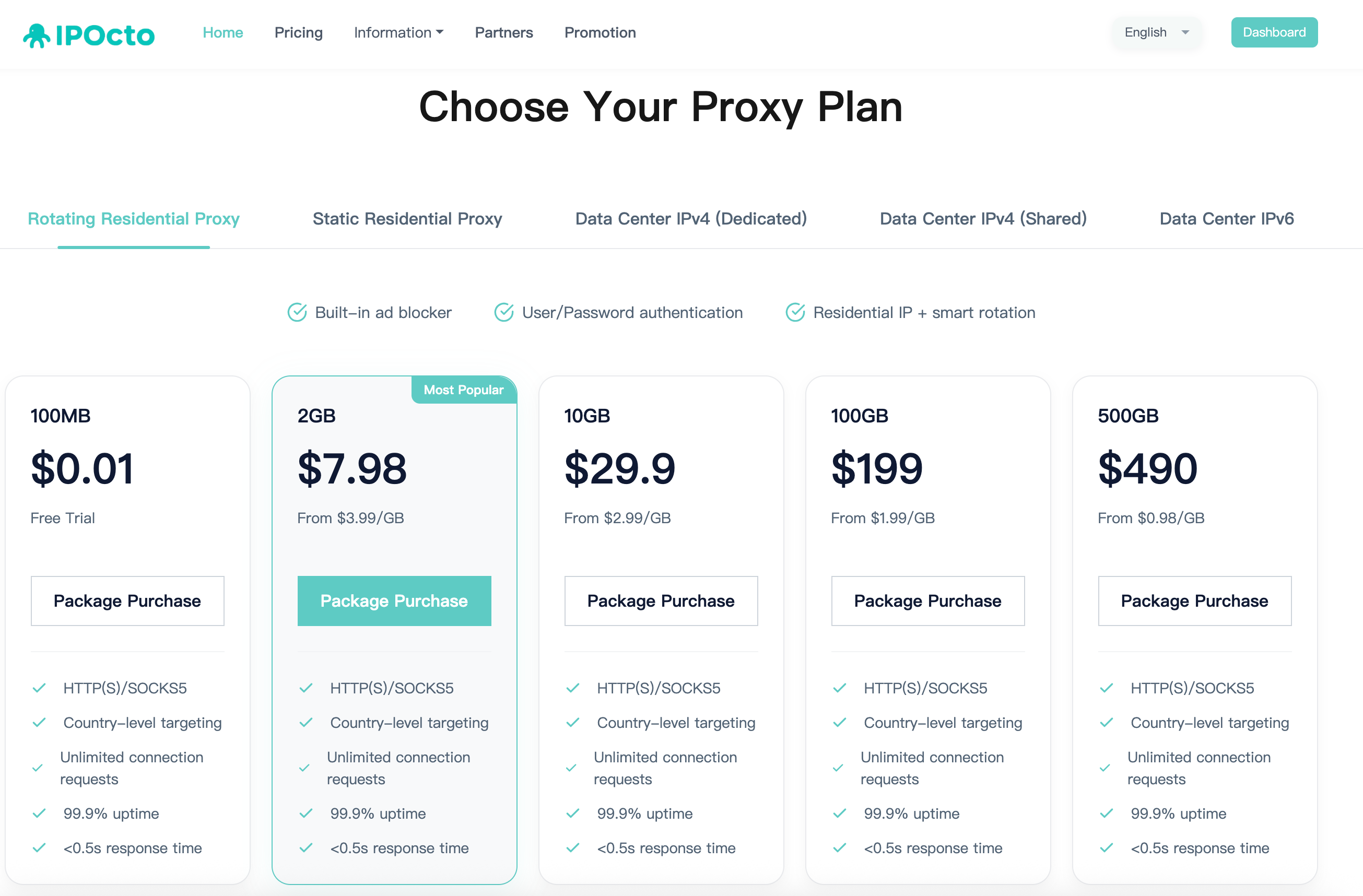
Taking IPOcto's public plans as an example, their design clearly demonstrates support for different business stages:
- Testing and Validation Phase (Small Number of Accounts): Offers extremely low entry barriers, such as 100MB free trials or small-value packages, allowing teams to validate technical feasibility at minimal cost.
- Rapid Expansion Phase (Dozens to Hundreds of Accounts): Plan capacity significantly increases, and unit prices decrease accordingly. For instance, transitions from 2GB to 10GB and 100GB cater to the IP consumption needs arising from increased account numbers.
- Scaling and Agency Business (Thousands of Accounts): Offers large packages such as 500GB. At this stage, the cost per GB is compressed to extremely low levels, making it ideal for enterprises or agents with massive IP demands, truly realizing the leap from 10 accounts to 1000 accounts.
| Business Stage | Typical Account Scale | Recommended Plan Capacity | Core Cost Consideration |
|---|---|---|---|
| Initial Validation | < 20 | 100MB - 2GB | Minimal trial cost, rapid validation |
| Growth Expansion | 20 - 200 | 10GB - 100GB | Balance usage and unit price, support stable expansion |
| Scaling / Agency | 200 - 1000+ | 100GB - 500GB+ | Pursue ultimate unit price, ensure sufficient supply for massive demand |
The advantage of this design is that businesses can precisely choose the most suitable plan tier based on their current account numbers and task density, avoiding resource wastage. When the business scale upgrades, simply switch to the next tier of the plan without changing usage habits or access methods.
A Real-World Scenario: Cost Optimization for Cross-Border E-commerce Store Group Operations
Imagine we are an expanding cross-border e-commerce company.
- Phase 1: We operate 10 stores on platforms like Amazon and Walmart. We use IPOcto's 2GB plan for store management, competitor monitoring, and ad placement, with controllable costs.
- Phase 2: Business growth is rapid. We launch 50 new stores in multiple countries, bringing the total account count to over 60. The 2GB plan quickly becomes strained, and frequent IP changes impact efficiency. At this point, we seamlessly upgrade to the 10GB plan. We have ample data, the cost per GB decreases, and the total expenditure increase is far lower than the increase in store numbers.
- Phase 3: The company decides to adopt a store group model and develop agency operations, aiming to manage a total of 500 stores. After evaluation, we directly opt for the 100GB plan. Although the plan cost is higher, the IP cost per store is actually lower than when using smaller plans, and management is more centralized and efficient.
Throughout this process, we don't have to worry about business interruptions due to IP resource shortages, nor do we have to pay for unused data. Costs increase linearly and controllably with business scale, which is precisely the core value of tiered plans in cost control for scaled matrix operations.
Conclusion: Let Resources Serve Growth, Not Restrict It
On the path to scaling business, every penny counts. IP, as infrastructure, has a cost model that directly affects the pace and sustainability of expansion. A flexible tiered plan system ranging from 2GB to 500GB is not just an enrichment of product options, but a design philosophy centered around the client's business.
It allows businesses to:
- Test from a small, viable scale.
- Find the cost point that best matches current needs throughout the growth process.
- Enjoy cost advantages from economies of scale when scaling up to large, platform-based operations.
Ultimately, businesses can focus more on the market, products, and users, rather than getting bogged down in the cost-effectiveness of their infrastructure. If you are also undergoing the transition from tens to hundreds or thousands of accounts, it's worth re-examining your IP resource strategy to see if it's truly supporting your growth, or if it's invisibly slowing you down. You can learn more about the details of their plan design by visiting the IPOcto official website and evaluating if it aligns with your business growth trajectory.
Frequently Asked Questions FAQ
Q1: I'm just starting with matrix operations and only have fewer than 10 accounts. Do I need to purchase a large plan? A: Absolutely not. For initial small-scale testing, it's recommended to start with the smallest plan or a trial package. The focus should be on validating the business model and IP tool stability, rather than making a large upfront investment. The advantage of tiered plans lies in starting from the lowest tier and expanding as needed.
Q2: What is the main difference between tiered plans and monthly fixed subscription plans? A: The core difference lies in flexibility and cost efficiency. Fixed plans require you to estimate your monthly usage in advance, often leading to "not enough" or "too much." Tiered plans (especially with data packages) allow you to purchase resources based on actual project consumption, providing longer usage, often without time limits, making them more suitable for businesses with fluctuating usage.
Q3: How can I determine which plan capacity my business should start with? A: A simple estimation method is to calculate the average daily/weekly data consumption per account for tasks, multiply by the total number of accounts, and then multiply by a safety factor (e.g., 1.2-1.5). For instance, if you have 10 accounts, and each account consumes an average of 50MB per day, that's approximately 15GB per month. Considering fluctuations, starting with a 10GB or 20GB plan would be reasonable. IPOcto's variety of capacity options allows you to find the closest tier.
Q4: When my account numbers expand from dozens to hundreds, is switching plans complicated? A: With services like IPOcto, switching plans is usually very simple. You just need to select the new plan capacity in the user backend and pay the difference. IP usage, API interfaces, etc., remain unchanged, allowing for seamless scaling of the business without disrupting ongoing matrix operations.
Q5: You mention "the leap from 10 accounts to 1000 accounts." For businesses truly needing thousands of accounts, how is the assurance of sufficient and stable IP resource pools guaranteed? A: This is a reflection of the service provider's comprehensive capabilities. Service providers capable of offering massive 500GB-level plans typically possess a large and high-quality resource pool and a robust dispatch system. When choosing, you can focus on their IP pool size, purity (residential/data center proxy ratio), and whether they offer dedicated proxy or large enterprise support solutions to ensure service stability under massive concurrent demand.