
From "Can't Afford to Test" to "Test Boldly": A Startup's Guide to Exploring Global Markets on a Shoestring Budget
From "Can't Afford to Test" to "Test Boldly": A Startup's Guide to Exploring Global Markets on a Shoestring Budget
In the early stages of entrepreneurship, startups often face a dilemma: on one hand, the vast potential of global markets is alluring, while on the other, limited seed funding makes every market test feel like walking on thin ice. Especially in fields like cross-border e-commerce, social media ad placement, and content localization testing, the cost of multi-market product testing can be prohibitively high. Have you ever hesitated to launch your product in a new country, fearing your ad budget would go down the drain?
The Pain of Market Testing for Startups: A Tug-of-War Between Budget and Risk
For startups and independent developers, resources are always scarce. When we try to validate a product concept's acceptance in different countries and regions, traditional market research methods are either costly (like commissioning local agencies) or outdated (relying on secondary reports). A more direct approach – running initial ad tests within the local network environment of target markets – faces two major obstacles:
- Geographical Restrictions: The performance, audience targeting, and even ad review processes of many advertising platforms (like Facebook, Google Ads, TikTok Ads) are deeply tied to the IP geolocation of the advertising account. Without a local IP in the target market, the authenticity and accuracy of the test are compromised.
- Cost Pressure: Acquiring stable, clean residential IP proxy services from the target market is traditionally considered a significant expense. For teams needing to test multiple markets simultaneously, configuring high-quality proxy services for each market individually would cause costs to skyrocket, making " low-cost product testing" a seemingly impossible feat.
Limitations of Traditional Proxy Solutions: Why They Don't Suit "Move Fast and Break Things" Testing
In the past, teams might have tried several approaches to address IP issues:
- Building Self-Hosted Proxy Servers: High technical barrier, immense maintenance costs, and difficulty in guaranteeing IP cleanliness, making them prone to platform risk control detection.
- Using Free or Cheap Datacenter Proxies: These IPs are often shared by many users, have been flagged by major platforms, and are highly risky, easily leading to account bans when used for advertising.
- Purchasing Expensive Static Residential Proxy Packages: While relatively stable, they often have high monthly minimum spend or traffic package requirements. When you only want to conduct a small-scale ad test in Malaysia for three days, consuming tens of dollars, you're forced to buy a monthly package costing hundreds of dollars, which is an undeniable waste of resources.
These methods are either uncontrollable in risk or uneconomical in cost, running counter to the core needs of startups for "agile, low-cost, and rapid validation."
Rethinking Product Testing Logic: Flexibility and Unit Cost Are Key
When we peel back the layers, we find that successful product testing strategies aren't about pursuing the most top-tier, stable network resources, but about achieving ultimate flexibility and controllable unit testing costs. An ideal solution should allow us to:
- Use on Demand, Pay Per Usage: Pay only for the actual traffic consumed, with no monthly minimums or bundled packages.
- Obtain Authentic Geographical Identity: IPs must come from real residential networks in the target country to ensure the maximum authenticity of the testing environment.
- Extremely Low Initial Cost Per Test: Empowering teams to dare to conduct parallel tests in multiple potential markets, with total costs remaining completely manageable even if most tests fail.
This represents a shift in business logic: transforming market testing from a "fixed capital investment" into a "variable operating cost." The key technological tool enabling this transformation is the dynamic residential proxy network that has emerged in recent years and is billed by traffic.
Dynamic Residential Proxies: How They Become a Startup's "Market Probe"
Dynamic residential proxies work by pooling the idle bandwidth resources of a vast number of real home users globally, forming a massive, worldwide IP pool. When a user connects, the system dynamically assigns a real residential IP from the designated country/city. This model offers several revolutionary advantages:
- Extremely High IP Authenticity and Cleanliness: Each IP corresponds to a real home network, significantly reducing the risk of being identified as a proxy by advertising platforms.
- Unparalleled Geographical Coverage: Easily switch to almost any country and region worldwide, meeting multi-market testing needs.
- Disruption of Cost Structure: Due to the shared utilization of a massive resource pool, the marginal cost is extremely low, allowing service providers to offer flexible billing models charged by GB or even MB.
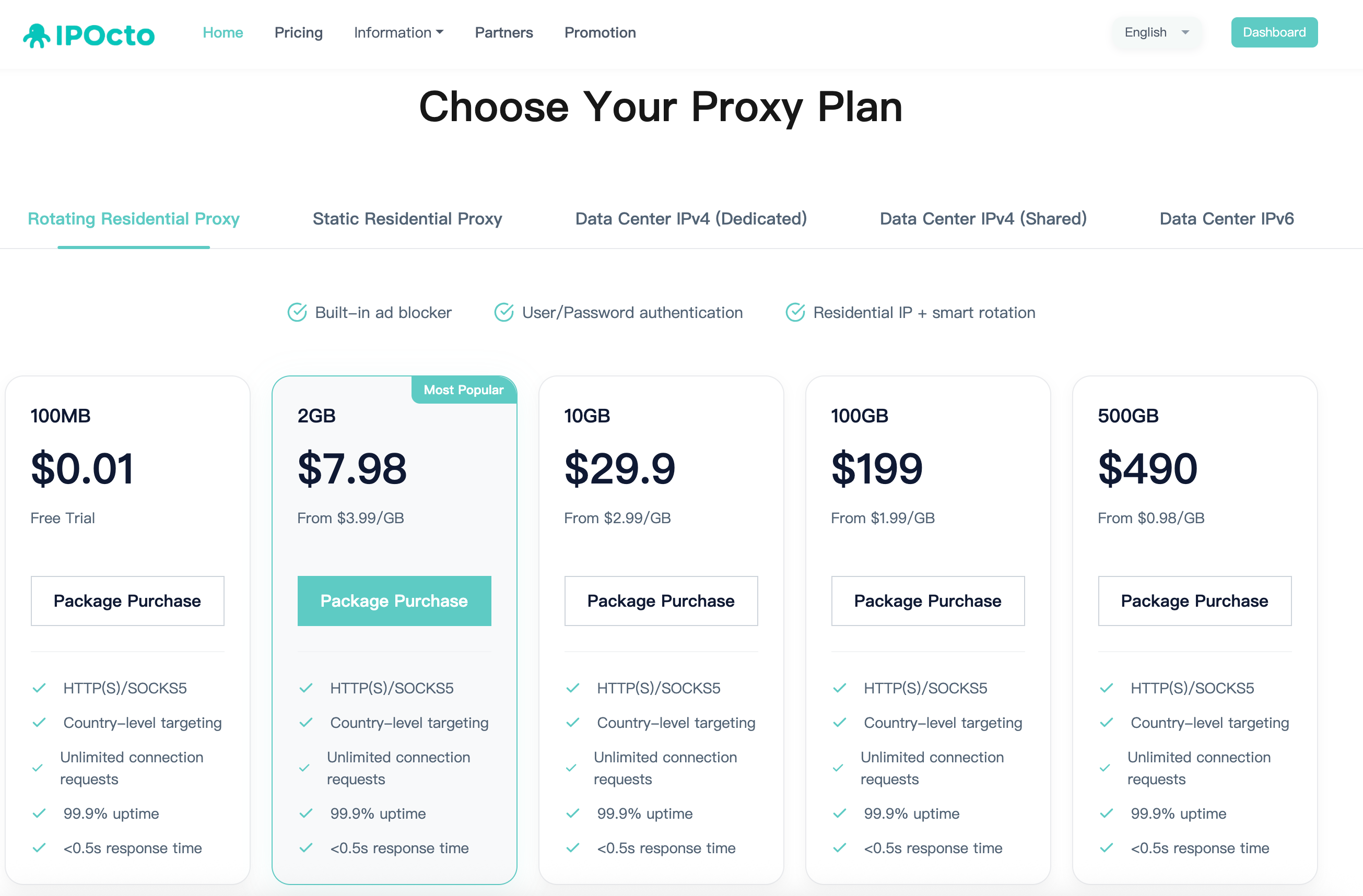
Take IPocto, a service our team uses, as an example. Its dynamic residential proxy service allows users to acquire 100MB of initial traffic for $0.01. This figure is worth pondering: it's not just a price, but a representation of a possibility – lowering the barrier to entry for a serious market entry test to less than the cost of a cup of coffee. This is a " dimensionality reduction attack" on the traditional high-cost product testing model.
A Real Workflow: Launching a Three-Market Southeast Asia Test for $0.01
Let me share a real case we recently conducted. We had a tool-based SaaS product and wanted to test users' initial interest in the Southeast Asian markets (Indonesia, Thailand, and Vietnam).
In the Past (Traditional Method): We would select the market we believed had the most potential (e.g., Indonesia), spend about $300 on a month of static residential proxies, meticulously design ad campaigns, and allocate a $200-$300 budget. The entire process was cautious, taking 2-4 weeks, with a total investment of about $500-$600, but only yielding single-point data for one market.
Now (Using IPOcto Dynamic Residential Proxies):
- Low-Cost Launch: We registered on the IPocto official website and claimed $0.01 in trial traffic. Total investment: 1 cent.
- Parallel Environment Setup: We created three separate social media ad accounts for Indonesia, Thailand, and Vietnam. Through IPOcto's control panel, we switched our connection IP to the respective capital cities (Jakarta, Bangkok, Hanoi) with one click.
- Micro Ad Campaigns: For each market, we designed simple landing pages and value proposition ads. The daily budget for each ad campaign was set at $5, planned for three days. The goal was to test click-through rates and registration intention, not direct conversions.
- Execution and Monitoring: Over three days, we ran three micro-campaigns simultaneously, with a total ad budget of: 3 markets * $5/day * 3 days = $45. Proxy traffic costs were approximately $1-$2 based on actual consumption.
- Data Analysis and Decision Making: After three days, we obtained clear comparative data. For instance, we found that the cost per click (CPC) in Thailand was much lower than expected, and registration intent was strong; while Vietnam's performance was relatively flat. Based on this, we decided to allocate the main budget for the next phase to Thailand and optimized ad creatives for Indonesia's data.
Comparison and Benefits:
| Comparison Item | Traditional Single-Point Test | Parallel Test with Dynamic Proxies |
|---|---|---|
| Monetary Cost | ~$500-$600 | ~$50 (Ads + Proxies) |
| Time Cost | 2-4 weeks (Sequential) | 3-5 days (Parallel) |
| Data Breadth | Data for 1 market | Comparative data for 3 markets |
| Decision Confidence | Medium (Single-point data) | High (Comparative data, excluding randomness) |
| Risk | High (Betting on a single market) | Extremely low (Dispersed testing, low cost for single-point failures) |
The total cost of this test was even lower than the proxy fees for one traditional test. More importantly, with extremely low marginal costs, we obtained a more comprehensive set of comparative data for decision-making.
Conclusion: Turning Uncertainty into Controllable Exploration Costs
For startups, the greatest advantage is not funding, but flexibility and speed. On the path to global market expansion, the biggest obstacles are often not technology or product, but the fear of making decisions due to information asymmetry. Dynamic residential proxies, especially services like IPOcto that offer excellent cost-effectiveness and flexible billing, essentially reduce this "information acquisition cost" to an unprecedented low.
It transforms " initial ad testing across multiple markets and multiple accounts" from an expensive and high-risk strategic move into a routine operational action that can be executed and iterated upon quickly. Every test, whether successful or not, becomes extremely valuable due to its low cost – success points the way, failure eliminates options.
The market doesn't wait for perfect plans; it rewards agile action. Perhaps the first step in exploring global markets next time can start with a "probe" test whose cost is negligible.
Frequently Asked Questions FAQ
Q1: Dynamic Residential Proxies vs. Static Residential Proxies: Which to choose for product testing? A: The core difference lies in the usage model. Static proxies have fixed IPs and are suitable for scenarios requiring long-term stable identity and in-depth operations (like managing long-term ad accounts or social media operations). Dynamic proxies have IPs that change by session or time, offering low cost and high flexibility, perfectly fitting "short-term, frequent, multi-region" product testing needs. It's recommended to use dynamic proxies for testing and validation, and then switch to static proxies for in-depth development in key markets after validation.
Q2: Will using such cheap proxies lead to ad account bans? A: The risk primarily comes from IP quality, not price. High-quality dynamic residential proxies (like those offered by IPOcto) source IPs from real home networks, ensuring high cleanliness and behavior patterns consistent with real users, leading to a much lower risk of bans compared to datacenter proxies. The key is to choose reputable service providers and follow platform rules (e.g., avoid frequent IP switching for abnormal operations).
Q3: Besides ad testing, in what other startup scenarios can dynamic residential proxies be helpful? A: The application scenarios are very broad: 1) Price Monitoring and Competitor Analysis: Anonymously visit competitors' websites in different countries to obtain local pricing and promotion information. 2) Content Localization Testing: Check your website's loading speed, display effects, and SEO rankings in different regions. 3) Social Media Trend Discovery: Browse social platforms as a local user to discover regional hot topics. 4) Accessing Restricted Resources: Securely access research materials, academic databases, or region-limited industry reports.
Q4: How to estimate the amount of proxy traffic needed for a test? A: Traffic consumption primarily comes from ad platforms' review personnel (and bots) browsing your landing pages. A simple estimation method is: assume each ad click consumes about 0.5-1MB of traffic (loading an optimized landing page). If you expect 100 clicks for a test, preparing 100-200MB of traffic is relatively safe. IPOcto's $0.01/100MB starter package is enough for several such micro-tests.
Q5: Do I need to purchase proxy services for every team member? A: Not necessarily. Many proxy services (including IPOcto) support creating sub-accounts or sharing connection credentials. A more common practice is to configure proxies at the team's shared ad management tool, browser fingerprint management software (like Multilogin), or the router/server level, enabling team-wide shared access and unified cost and permission management.